The use of recycled materials is now on the agenda of almost every plastics processor – driven by regulation, sustainability targets, customer expectations, and volatile raw material markets. Hardly any strategic roadmap today excludes the topic of circular economy. And yet, many projects still fail. Not in the laboratory. Not during pilot testing. But in economic reality.
Why? Because recycled material usage is still too often treated purely as a “materials purchasing project”. In reality, it is fundamentally a raw material, supply chain, and strategic business issue.
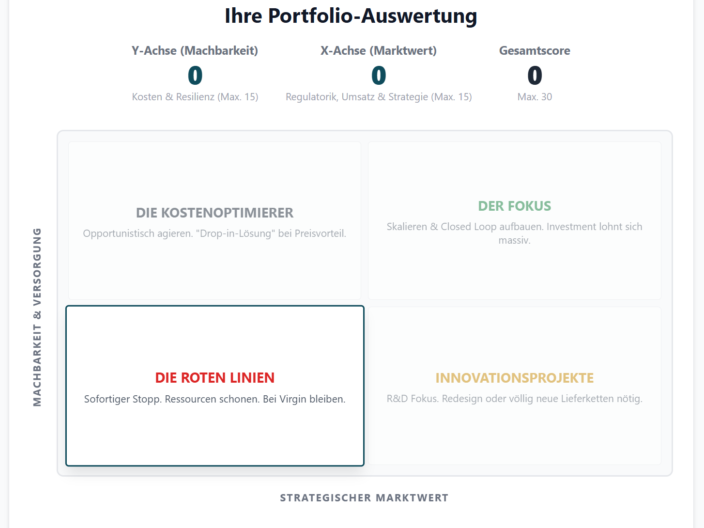
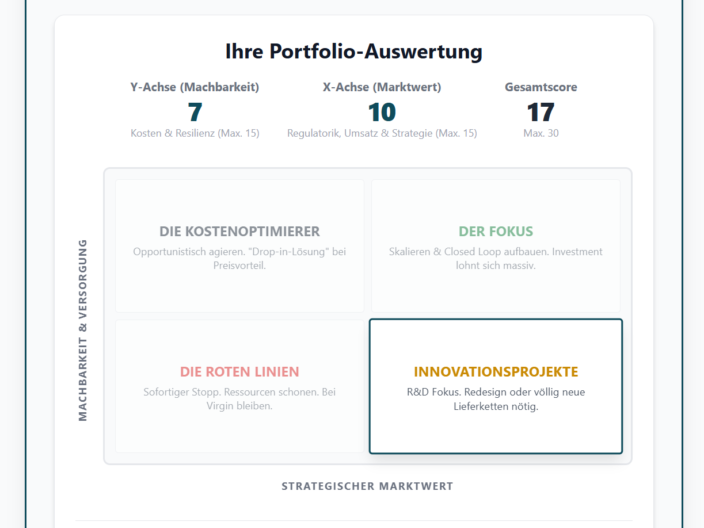
This whitepaper explains why the bottleneck is rarely the material itself, but almost always the system behind it. It also provides decision-makers with a field-tested assessment tool and decision matrix to evaluate, on a data-driven basis, where recycled material usage and closed-loop systems genuinely create value.
1. From Hype to Reality: The Market Situation
The days when circular economy initiatives were merely a “nice-to-have” for CSR reporting are over. While the topic stood unchallenged at the top of strategic agendas just a few years ago, disillusionment quickly followed: the recycled-content quotas demanded by regulators and society significantly exceed the actual availability of high-quality recycled materials.
Today, looking towards 2026, the market is characterised by cost pressure and declining demand. Many companies have reverted to pure cost optimisation. Recycling capacities across Europe are being lost, and waste is once again being incinerated instead of sorted and recycled.
The circular economy is no longer just a corporate sustainability strategy – it is a question of industrial competitiveness and a critical lever for supply chain resilience.
2. The Biggest Misconception in the Use of Recyclates
The most critical mistake many companies make lies in their approach. In practice, recycled materials are still procured far too often in exactly the same way as virgin materials.
⚠️ The trap: Procurement requests established specifications, datasheets, and an initial sample. The sample performs well, the project is approved. But once serial production begins, fluctuations in MFR, colour deviations, or contamination issues emerge. Production stops, scrap rates increase, and the project is considered a failure. Why?
Because recyclates are sourced like virgin materials, while the underlying system and batch variability are ignored.
The Paradigm Shift: Application-Based Instead of Material-Driven
The starting point for every successful sourcing strategy is the application – not the material itself:
- Which fluctuations are technically and economically tolerable in production?
- Which certifications and proof points are required today and in the future?
- Where will my future raw material originate, and how do I secure access to homogeneous waste streams?
3. Sustainability as a Business Case
In the past, recycled materials were often viewed primarily as a cost factor – with uncertainty as to whether customers would absorb the additional expense. Today, the strategic perspective has changed: circular economy is a tool to generate return on investment (ROI) and minimise fundamental business risks.
Companies with access to stable material streams become less dependent on volatile international supply chains and can significantly reduce exposure to raw material price fluctuations.
Today, cost, revenue, regulatory compliance, and supply chain resilience are the primary and hard business arguments for management teams.